Fahrenheit 451 - Book review
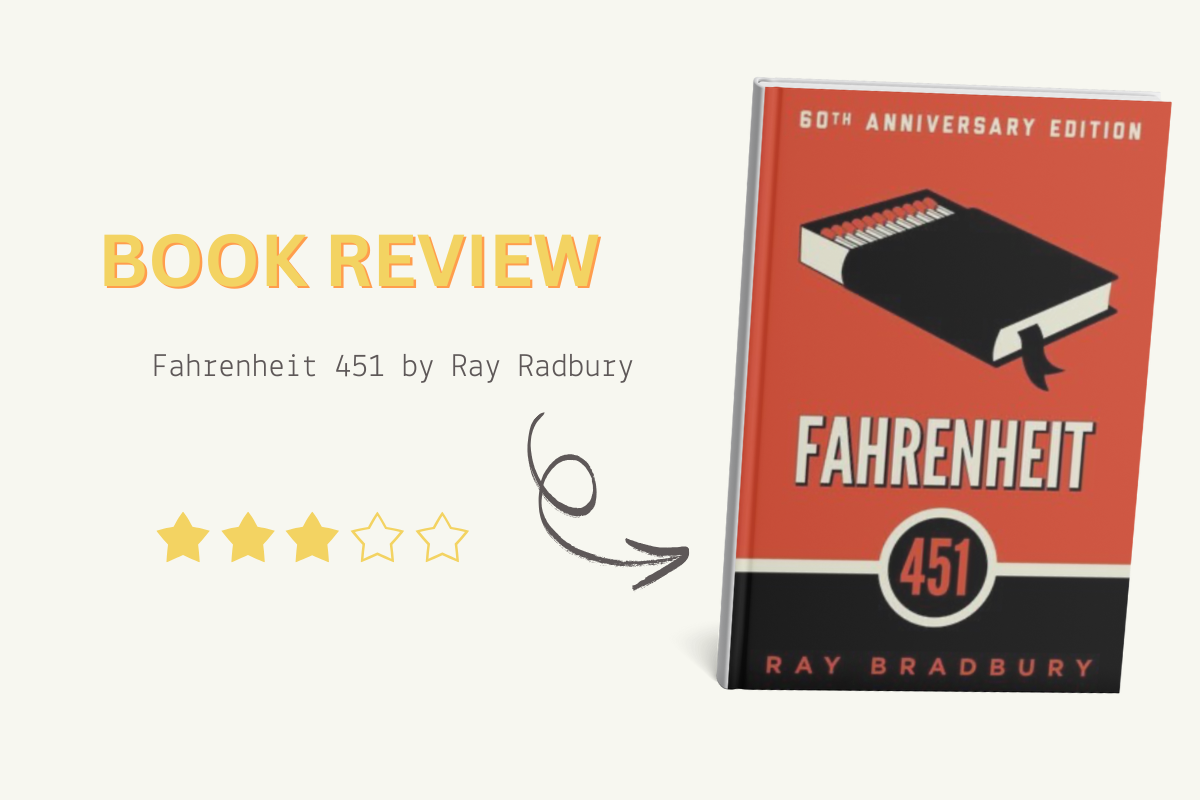
Fahrenheit 451 is a dystopian classic written by Ray Radbury and first hit the shelves in 1953. Many of us have either heard about the book or read it ourselves. Thus, it was high time I picked it up too! I went for the audiobook version on Libby, taken from my local library. (As always, support your local libraries!)
In the next sections I will dive into what Fahrenheit 451 is about, my thoughts, and my final verdict. In case there are any spoilers, you will be warned ahead so you’ll get to decide whether you’d like to continue reading this blog post or come back after you’ve read the book. ;)
The blurb
Nearly seventy years after its original publication, Ray Bradbury’s internationally acclaimed novel Fahrenheit 451 stands as a classic of world literature set in a bleak, dystopian future. Today its message has grown more relevant than ever before.
Guy Montag is a fireman. His job is to destroy the most illegal of commodities, the printed book, along with the houses in which they are hidden. Montag never questions the destruction and ruin his actions produce, returning each day to his bland life and wife, Mildred, who spends all day with her television “family.” But when he meets an eccentric young neighbor, Clarisse, who introduces him to a past where people didn’t live in fear and to a present where one sees the world through the ideas in books instead of the mindless chatter of television, Montag begins to question everything he has ever known.
(source: https://www.goodreads.com/book/show/13079982-fahrenheit-451)
Thoughts on the book
Speaking of, some books are actually already banned in various countries for different reasons and removing access to literature has occurred multiple times over the history of humankind.
The thought of never being able to hold a book and enjoy its contents again sends shivers down my spine. The loss of language, imagination, and stories that would come with it - unimaginable!
For me personally, though I enjoyed the overall plot, I didn’t quite click with Montag (I am also still not sure if that is his first or last name.) I can’t tell if that would have been different if I had opted to read a physical copy of the book. I did however, like the interactions between the protagonist and Clarisse, the 17-year old “odd” neighbour. I won’t lie to you, I did hope that nothing romantic would happen between the two of them.
Shifting the topic of anti-intellectualism back to our present time: Our mindless media consumption may actually not seem too far off from being identical to what was happening in the book, doesn’t it? If we talk politics, it often seems like the loudest people gain the most traction and media presence, online podcast debates are flooded with “facts” , AI scams are everywhere, and I wonder how the reading comprehension of kids nowadays is impacted by the screens they have been handed at an early age as means to keep them quiet and entertained.
This section will include spoilers of the book. You have been warned :)
I’m not quite sure how I feel about the ending, Montag finding and joining a community of intellectuals who memorise books to pass it on to the next generation. The ending could have been any, in my mind:
Clarisse being alive after all and instead being found with the intellectuals and thus, being reunited with Montag
Montag’s wife waking up from the haze and joining her husband in the rebellion
Captain Beatty telling Montag that he understands him and admitting to having a stash of secret books
etc.
I believe that this is also what makes the book special in its own way. It’s a dystopian fiction after all - one is left to think about what alternatives lie beyond what the author has given us.
Memorable parts of the book
This section will include spoilers of the book. You have been warned :)
Clarisse McClellan: In a world that tries to dictate how you should behave, it is a rebellious act to be yourself. Clarisse and her family truly embodied that with being the odd ones out by not only being curious but seeming to be genuinely happy.
Mildred’s suicide attempt: An empty bottle of pills, Montag’s desperation and Mildred’s avoidance of talking about anything that would have gone deeper that remaining on the surface - a brutal picture painted by the author.
The hound: I had trouble at first imagining what the creature looked like, but it never fails to amaze me what horrible ways humans come up with, to create devices that will inflict pain on others.
Captain Beatty’s death: I did not expect him to die or to die by the hands of the protagonist.
Verdict
3/5 stars
I understand why Fahrenheit 451 is considered to be a classic piece of literature. Though written many years ago, it holds meaning even in today’s day and age, because I believe that it is never far off from a potential reality.